

Let’s look at seven common challenges therapists face in creating structure.
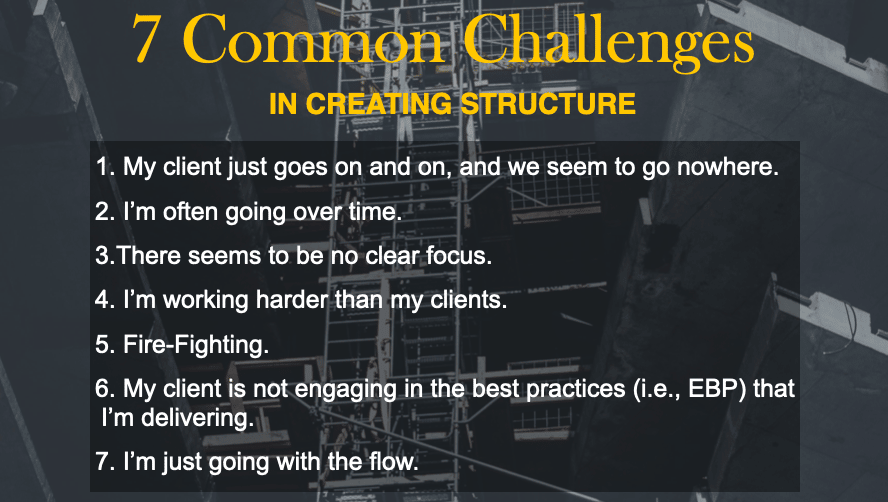
1. “My client just goes on and on, and we seem to go nowhere.”
Beginning therapists think it’s a good thing to let a highly verbose go on. He powers through from topic to topic. Everything seems relevant. He hardly stops to catch a breath.
So what does the therapist do? He lets the client speak his mind.
The therapist assumes the client is highly engaged.
And if you are tracking the session-by-session alliance at the end of the session, you suddenly realised that the client was speaking out of anxiety, not knowing where the conversation was going. The client rates the Approach and Focus sections of the alliance slightly lower than the rest. And then the client discloses that he has no idea where the session was going.
2. “I’m often going over time.”
Don’t be embarrassed. All of us struggle with finishing on the arbitrary therapy hour.
Who determined this anyway? Was there a town hall meeting that I missed?
The time constraint can actually be useful. Constraints are paradoxically useful for creativity.
Without constraints, we lack structure.
Time is not your enemy. Using timing well can help you create an impact.
Think of a movie. Imagine if it just goes on and on. You’d be bored stiff.
We need some sort of guide within the hour.
I have more to say about how thinking in thirds can be helpful.
RELATED:

Thinking in Thirds: Going Deeper (Part II of III)

In Part I of Thinking in Thirds, I talked about the rule of three in various domains like the performing arts, storytelling and music, and how segmenting the therapy hour into thirds can be structurally (not rigidly) helpful.
Thinking in Thirds Closing The Session (Part III of III)

In the previous 2 parts on Thinking in Thirds, I've detailed about the process of Stage 1 of creating an invitational beginning and Stage 2 of deepening the process in the therapy hour.
3. “There seems to be no clear focus.”
Especially when the client presents with multiple challenges and layers of complexity, it’s easy to get lost.
It’s not just about setting SMART goals.
It’s about directionality.
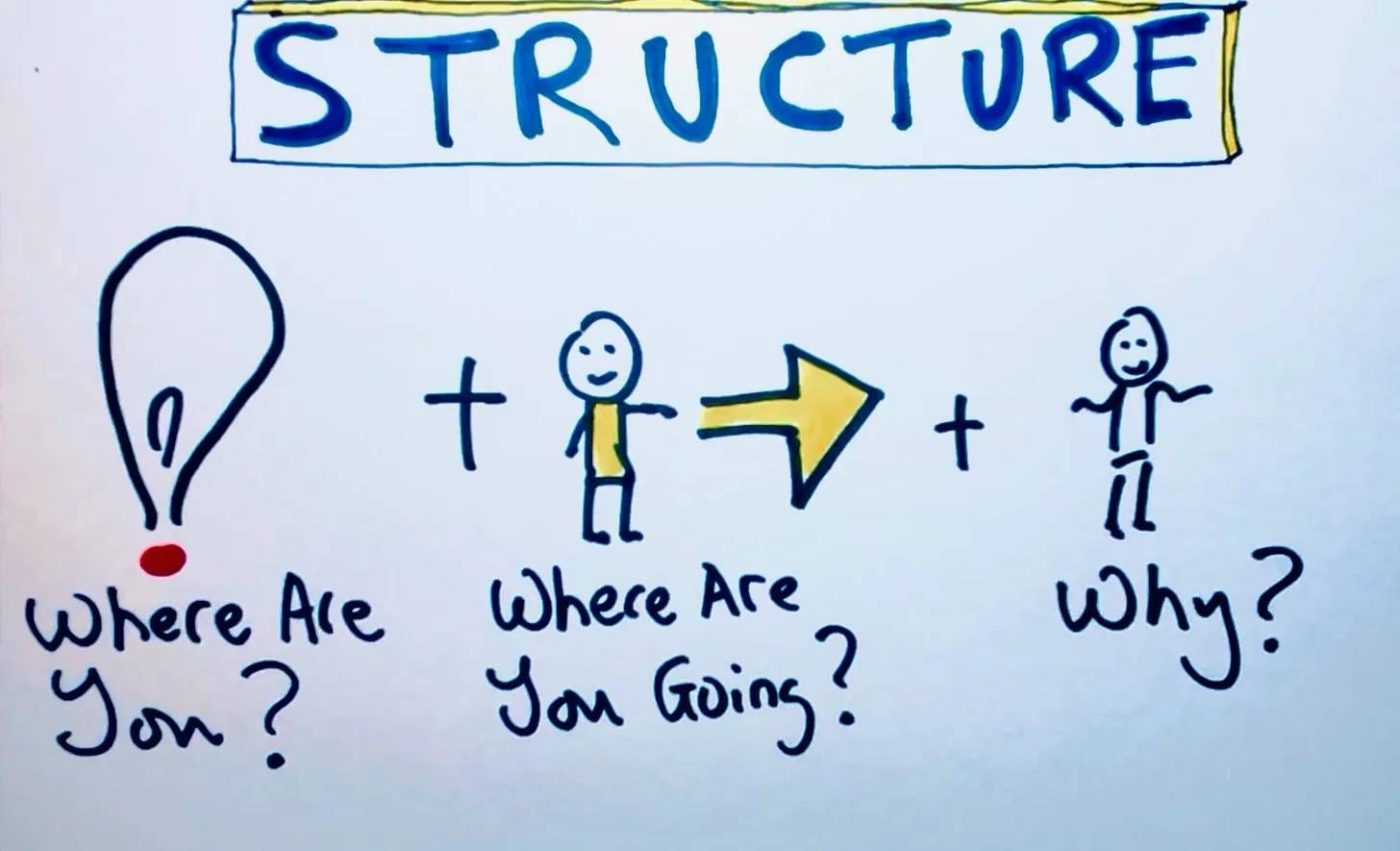
Do you know where the client is, where she wants to go, and why?
MORE ABOUT STRUCTURE:

4. “I’m working harder than my clients.”
When we don’t know or assume where the client should go, and their reasons behind it, instead of being the guide, we end up being in the driver’s seat for the journey.
You become more motivated than your client.
This is not about taking a backseat. But if you are driving the session all the time, it may be due to a lack of agreement of the direction to take and the reasons to go there.
You push instead of letting the client’s Why pull you there.
There also might be a lack of clarity of where the client is at!
This dance requires us to work together, not pull them into an unwanted tango.
5. Fire-Fighting
This is common among seasoned therapists.
For some clients, the therapist feels like they are putting out new fires at every session.
The goalposts keep shifting; the outcomes remain the same.
One can rationalise that this is due to the complexity of the client’s life. Besides, you can’t just leave the fires alone, can you?
Therapy need not be just about downstream fire-fighting stuff. The real work requires upstream thinking, looking for the source of the fire, hitting the nerve centre of things.
This requires a steady guiding hand.
Structure is there to hold and contain and to point towards the art of possibilities.
6. “My client is not engaging in the evidence-based practices that I’m delivering.”
This phenomenon tends to happen right after we attend a workshop in a new method of treatment.
We leave the workshop full of hope. Besides, there is empirical evidence behind what you’ve just learned from the leading figure of that therapy approach.
We now have a “structure” to employ.
But your clients don’t comply.
They don’t do the prescribed homework, and they either look at you kinda weird, or simply just smile at you with a “yeah, but,” kind of smile.
I got that look after I came back from a narrative therapy workshop. My clients had no idea what my convoluted statements meant. I persisted. My “externalising the problem” questions became more entangled.
Early in my career, I attended a brilliant workshop by a giant in the field. He was persuasive, and the evidence presented was convincing.
I was convinced.
But my clients weren’t.
Hardly any client was lapping it up. I thought to myself, I sucked at it because I couldn’t get clients to complete their CBT homework.
Was I doing something wrong? Am I not cut out for this?
Years later, I confided my shame to an invited CBT speaker who presented at the psychiatric hospital I was working in. He said to me, “You know, a CBT practitioner will not go and see another CBT practitioner for help.”
Sometimes, the attempted solution is the problem. Some clients are already employing the approach you are suggesting, and it’s not helping.
It doesn’t matter whether what you are doing is empirically-supported. If it doesn’t resonate, don’t be tone-deaf.
Allow yourself to be altered.
7. “I’m just going with the flow.”
I hear this one a lot.
We need to go with where the river flows, but you can’t jump in without a boat.
You are there to guide.
Our hearts must be open, but your mind must have a scaffold to lean on especially when the seas get rough.
Winging it is a lazy response.
Improvisation is not just “winging it.” The great jazz musicians look like they are. They aren’t. They lean on principles of music, and remain ultra responsive and adaptive to the other musicians.
When There is No Structure
What happens when we don’t create a sense of structure in therapy?
Once again, structure as I see it, is not about formula, but form. It is a scaffold to help you build what you are to build with your clients.
Scaffolds are not there to be glorified. They are taken down once the building is done.
Here are three potential consequences when structure is missing:
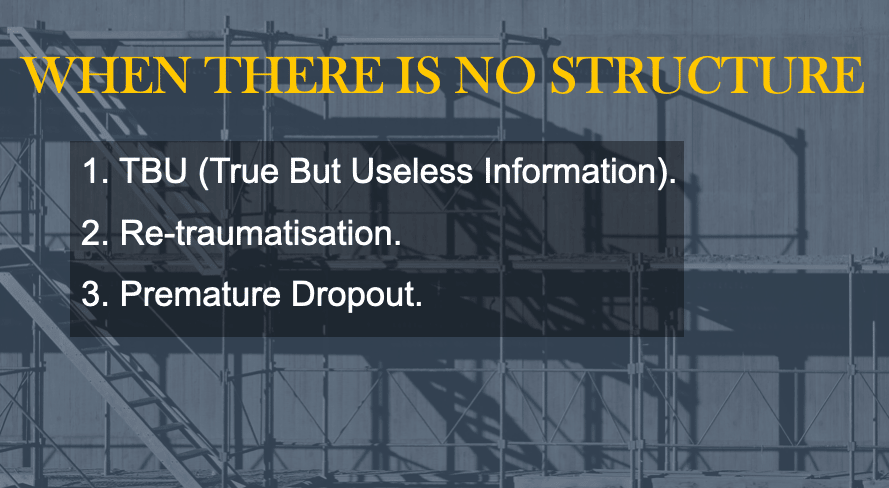
1. TBU (True But Useless Information).
I talked about this in The First Kiss.
When we impose our clinical intake structure on our clients, we risk gathering all sorts of information that might not be aligned with the client’s intentions of being in therapy.
Structure in therapy is there to hold and contain the therapeutic endeavour with our clients, not imposed on them.
Here’s the chapter on TBU.
2. Re-Traumatisation
When we shoot from the hip with our questions without a clear structure, informed by reasons that matter to our clients, we risk re-traumatising our clients.
They don’t see the purpose of your questions.
They don’t share the worldview that you have to look at the past in order to heal—at least at this point in time.
I heard a person come out of a session at a mental health centre and say to her mom in the waiting room, “Why should I come here and reveal my feelings?! What good does that do, opening up old wounds?” She burst into tears. I would speculate that the therapist and client have not yet formed a consensus about what to talk about.
Agreement on direction (i.e., “where are we going?”) is part of creating structure.
3. Premature Dropout
When a client is not “clicking” with you, it’s partly due to you not “hitting the spot.”
Not getting where they are at, where they need to go, and not awakening the driving forces inside them, can lead to dropout.
The best well-laid plans are moot if the client’s will is not mobilised.
Unplanned termination occurs about 25% of the time in therapy.
We can do things to reduce it. (see this series: Part I, II, III).
RELATED:
Structuring a Therapy Session to Create Impact

If you are on the move, listen to the Frontiers Radio audio version, or anywhere else you get your podcasts.

The new cohort of Structure and Impact is now open for registration.
Start Date: 27th of Apr 26, Monday.
Format: 1 new in-depth section for four weeks.
The course is designed to be a combination of learning with a community + self-paced, along with a life-time access to the entire content, discussion, and updates.
As subscribers to Frontiers of Psychotherapist Development (FPD), you receive a special 10% discount.
At checkout, enter the following promo code: FPD10
For more info and to register, click below.
Notice Board
My sincere apologies to workshop registrants in Denmark for my recent cancellation. Due to the uncertainty at airport transits at this stage, I couldn’t commit to running the training. I hope we can come together in the near future.
Thanks to Australian Educational & Developmental Psychology Association (AEDPA) for hosting a second virtual training with me on clinical supervision.

Daryl Chow Ph.D. is the author of The First Kiss, co-author of Better Results, The Write to Recovery, Creating Impact, and the latest book The Field Guide to Better Results. Plus, the latest book, Crossing Between Worlds.

You might be interested in my other Substack, Full Circles: Field Notes on the Inner and Outer Life. FC is a return to soul and sanity, beyond the hollow promises of self-help tips and tricks.

Just what I need to learn… when will the course be offered again?