
Experience Doesn't Make You Better (Frontiers Friday #230) ⭕️
And all our deeply held assumptions.

This is from a recent podcast interview on Therapist Confidential, by Psychotherapy.net Academy.

You can also play this on Spotify or wherever you listen to podcasts.
From the blurb:
In this episode of Therapist Confidential, Travis Heath speaks with psychologist and researcher Dr. Daryl Chow about what actually makes therapists effective.
Drawing from decades of research on deliberate practice and feedback-informed treatment, Daryl challenges some of psychotherapy’s most comfortable assumptions—including the idea that experience alone leads to better outcomes.
Together, they explore why therapists often stop improving, the difference between performance and learning systems, and why humility, curiosity, and surprise may be hallmarks of highly effective clinicians.
The conversation also touches on premeditated treatment plans, the limits of psychotherapy models, the role of good conversation, and what human therapists offer that AI cannot. A thoughtful, grounded episode for anyone serious about becoming a better therapist.
Travis Heath’s questions brought us to interesting places.
Here are the timestamps:
Introduction and Professional Background [00:00:00].
Defining Deliberate Practice and Feedback-Informed Treatment [00:03:04]:
- Deliberate practice is not about competency but is focused on individual excellence.
- Being informed by our outcomes, session-by-session, client-by-client should be at the foundation.
- Formalised education often turns clinicians into “explainaholics” who are too removed from the actual conversational nature of therapy.Challenging the Myth of Experience [00:07:06]:
- Sobering evidence that clinical experience does not predict outcomes.The “Scandal” of Learning [00:12:59]:
- Why therapists often become “stale” in their practice.
- Why the “lack of transfer” occurs; information learned in a classroom often fails to translate into real-world clinical improvements.Building Expertise: Scaffolds and the Jazz Metaphor [00:16:46]:
- True expertise requires a “scaffold” that tracks outcomes to identify non-random patterns in a clinician’s work.
- An expert therapist is akin to a jazz musician who adapts spontaneously to the “key” of the conversation rather than strictly following “sheet music”.Therapy as a Deep Personal Conversation [00:19:38]:
- The fundamental base of therapy is having a good conversation.
- The most professional action a therapist can take is, paradoxically, to “get personal” and allow a real emergence of dialogue.The Three Layers of Conversation: What is Said, Unsaid, and Can’t be Said [00:24:01]:
- Moving from information gathering to identifying what a client “will say, won’t say, and can’t say”.The Value of Surprise and Feedback in Growth [00:30:58]
- Highly effective therapists report being surprised by client feedback more often than average practitioners.
- By making predictions about a client’s session rating and being “wrong,” a therapist is forced to listen differently and close the distance between their perception and the client’s reality.Performance Systems vs. Learning Systems [00:33:14]:
- An overemphasis on performance can impede learning.The Pitfalls of Premeditated Plans [00:36:08]
- Warning against “ecological fallacy.”
- The mistaken belief that group averages from clinical trials apply perfectly to the unique individual in the room.
- Therapeutic models can be used as “generative ideas” rather than rigid, premeditated plans.Therapy as a Team Sport and the Concept of “Scenius” [00:41:17]:
- “Scenius” a term coined by Brian Eno, to counter the notion of a lone “genius.”Cultivating Humility through Strength and Warmth [00:43:13]
- Effective therapy requires an oscillation between strength (having a spine) and warmth (opening one’s heart).
- Humility is defined as a “graceful self-forgetting” where the clinician is no longer focused on themselves but is fully immersed with the client.The Limits of AI: Sycophancy, Deception, and Affect [00:47:09]:
- A critique of generative AI tools like ChatGPT
- Issues of sycophancy (flattery), misaligned incentives, deception.
- “The mind needs another mind” to grow, as machines lack true comprehension and affect.
- (Note: I’ve written a whole series about my concerns here and here).Conclusion: When Therapy is “Alive” [00:54:40].
RELATED
This is for those who want to explore further.
I looked at the transcript, and matched related topics in my notetaking application, Obsidian.
Here’s what it looks like.
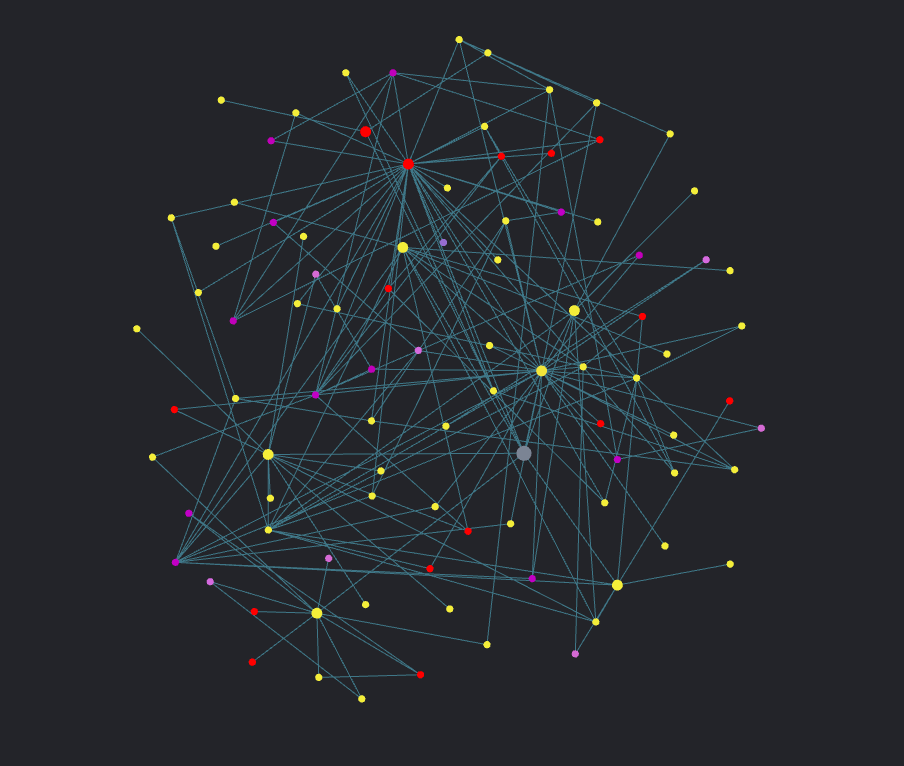
The conversation is not as confusing as the graph.
Here are some of the related stuff:
Conversational Depths in Therapy #210 ⭕️

In my other Substack Full Circles, I talked about our yearnings for deeper conversations in our relationships.
Psychotherapy: A Sacred and Subversive Act. Frontiers Friday #161 ⭕️

I often think about this profession of psychotherapy.
The Unspeakable in Therapy. Frontiers Friday #170 ⭕️ (Part I)

You would think that therapy would be the one place you can speak the unspeakable, and talk about the unspokens in one's life.
Notice Board
Apologies I haven’t been as regular on Substack. I’ve been caught up with the limited series newsletter that you might be receiving.
And I’m working on more topics for HomeKit, an audio series to help you get unstuck. I hope you check it out.Welcome new readers of Frontiers of Psychotherapist Development! I’m not sure the reason I’m getting more subscribers than usual in the last few months when I haven’t been writing as consistently here.
If you are new to FPD, drop me an email to say hello.Thanks to the Amherst Psychology for hosting a follow-up training. Good to meet new and familiar faces.
Thanks to the Psychological and Counselling Services at Curtin University for an intimate and intense 2-day workshop. For both agencies, love to see how things grow for you.
Upcoming Deliberate Practice Training in Copenhagen:
My colleague and friend Bruno Vinther is inviting me to run a one-day workshop in Denmark.
If you are in that region, I hope you can join us for this in-depth workshop.
For more info, see this pdf.
Date: 27th of April 2026.
Registration details here.
Note: Bruno just said last night, only 1-2 more spots left.

Daryl Chow Ph.D. is the author of The First Kiss, co-author of Better Results, The Write to Recovery, Creating Impact, and the latest book The Field Guide to Better Results. Plus, the latest book, Crossing Between Worlds.

You might be interested in my other Substack, Full Circles: Field Notes on the Inner and Outer Life. FC is a return to soul and sanity, beyond the hollow promises of self-help tips and tricks.

Brilliant breakdown on the role of feedback surprises. That jazz metaphor really clarifies how adaptive practice beats rigid models everytime. I've noticed in my own work that moments when clients rate sessions differently than I predicted are often where the breakthroughs happen, which aligns with wat this suggests about closing perceptual gaps.